01 Special Reports
At a glance
The election changes the balance of power in Washington. For the stock market, the useful question is what could change in companies' taxes, costs and profits.
At the November 4, 2026 check, around 1:46 a.m. EST, the Associated Press reported that Democrats had won control of the House of Representatives and the Senate. Calling the winners is different from formally certifying the results. Not every race needs to be over for a chamber's majority to be established.
Donald Trump remains president. The new Congress begins its term on January 3, 2027, while the current presidential term is scheduled to end on January 20, 2029. That means a Republican president and a Democratic-controlled Congress: power divided between the parties.
My takeaway: the election result is worth following, but it is not enough on its own to decide whether to buy or sell. What matters is which policies actually take effect and how they affect businesses.
02 Special Reports
1. What a Congress controlled by the other party can do
For an ordinary federal law, the House and Senate must approve the same text. The bill then goes to the president.
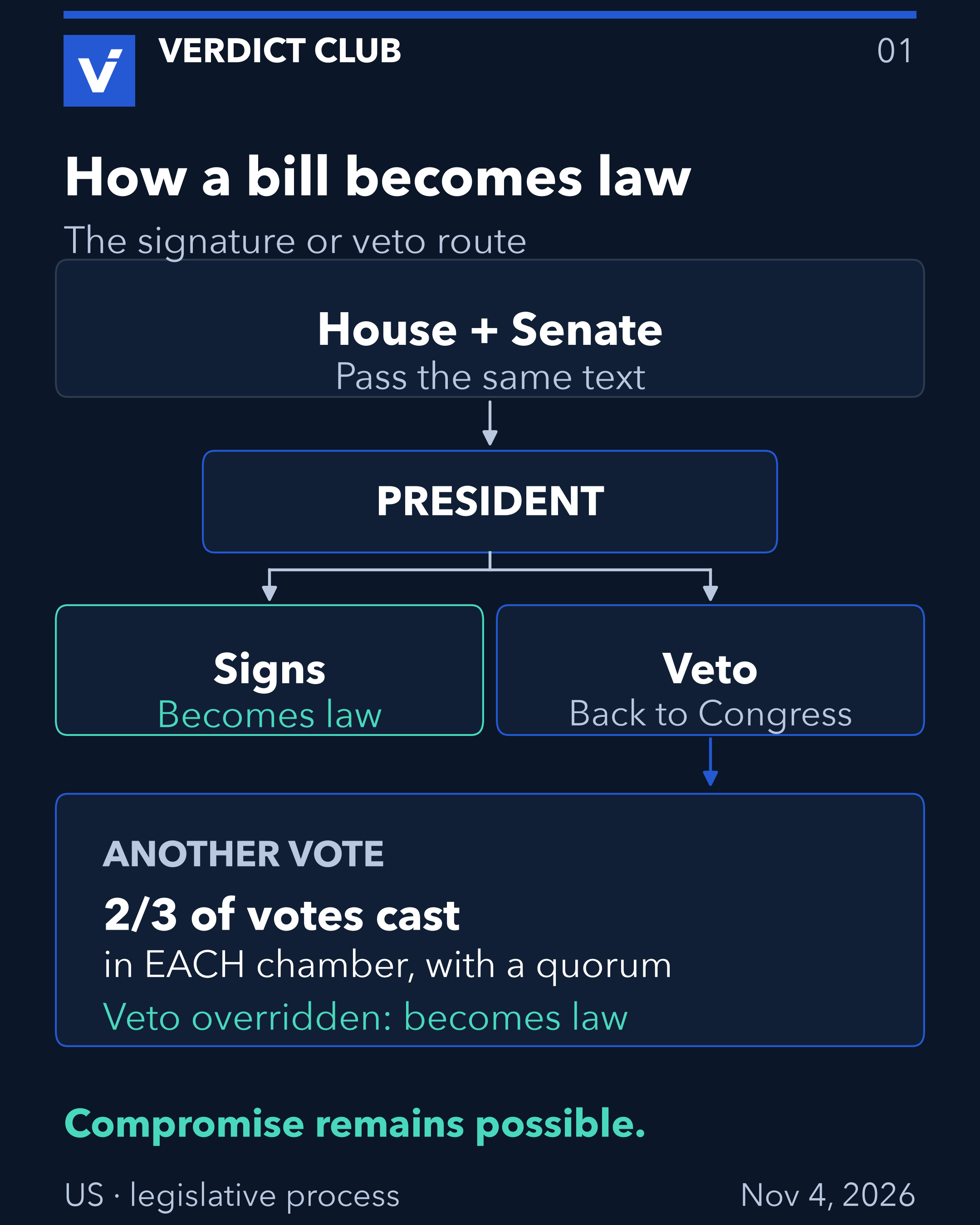
The president can sign the bill or reject it with a veto. Overriding a veto requires two-thirds of the votes cast in each chamber, with a quorum—the minimum number of members required for a valid vote. A simple majority is not enough.
The diagram shows the signing or veto route. Under the Constitution, a bill can also become law without a signature if the president does not return it within ten days, excluding Sundays, subject to the Constitution's conditions. An exception applies if Congress adjourns in a way that prevents its return.
Democrats therefore cannot change every federal tax on their own simply because they have a majority. They would need the president's agreement or enough votes to override a veto. That does not mean no laws can pass. It means negotiation and compromise become more important.
03 Special Reports
2. Political gridlock can help, but it has costs too
When the parties check each other, major legislative changes can become harder to pass. For some companies, a lower chance of sudden changes in taxes or rules can mean more predictability.
There is another side. Disagreements can delay budgets, funding or projects. If the necessary funding is not approved, some federal government operations can temporarily shut down. A funding shutdown is different from a sovereign debt default, although debt-ceiling disputes can create other risks.
The president and administration also retain certain executive powers. Decisions on trade, enforcement of regulations and foreign policy can continue, within the law and subject to court oversight. Divided power between Congress and the president does not freeze all economic policy.
That is why “political gridlock” is not an automatic signal that stocks will rise. It can reduce some risks and create others. Historical average returns under different political arrangements do not prove that the party in power caused those returns.
04 Special Reports
3. What the market shows, before we attach a story to it
The S&P 500 closed the November 3 session at 7,568.92 points, up 0.36% from the previous day. That close came before the election outcome reported overnight. It is not the market's final reaction to the election.
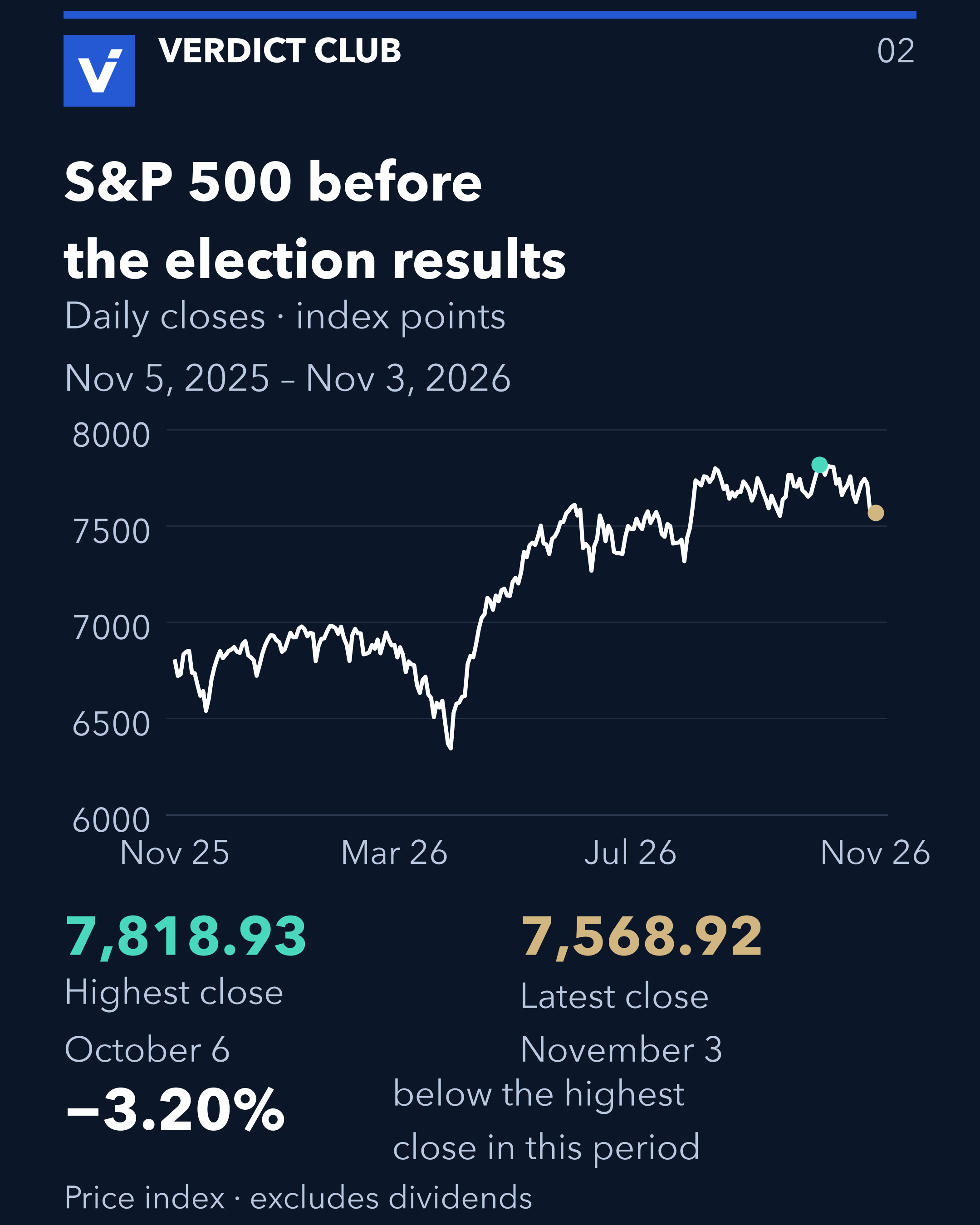
At that close, the index was about 3.20% below the highest close in the one-year period reviewed: 7,818.93 points on October 6. I am using the highest closing value within this period, not a verified all-time high over the index's entire history.
At 1:46 a.m. EST on November 4, the December E-mini S&P 500 futures quote showed a decline. Futures are contracts that also trade outside the stock market's regular hours and can react to overnight information. They are not the same instrument as the cash index and do not represent the November 4 regular-session close.
The direction can change before the open or afterward. But a red screen alone does not tell us that investors are “panicking.” Nor is there a solid basis for promising that everything will be reflected in prices by the following week.
05 Special Reports
4. What this means for AI and data centers
An election result does not automatically cancel demand for Apple phones, NVIDIA chips or artificial intelligence services. Taxes, trade rules, financing costs and public spending can still affect sales, margins and investment. The effect needs to be checked for each business.
For data centers, many location and permit decisions are made at the local or state level. Projects also depend on power infrastructure, grids, fuel and, in some cases, federal rules or approvals.
Moving a project to another state may be an option, but it requires land, available power, connections, equipment, permits and time. Changing the address does not remove every problem.
Bloom Energy is worth watching in the discussion about on-site power generation. Its fuel cells produce electricity through an electrochemical process. They may help some projects, but do not remove the need for fuel, equipment and approvals. An Oracle project announced in New Mexico illustrates the environmental checks and operating conditions that can still apply.
I would watch contracts, capacity actually delivered, costs and the resulting profit. I would not treat a change in the congressional majority alone as a sufficient reason to buy Bloom or any other company.
06 Special Reports
5. A lower share price does not automatically mean a cheaper stock
To assess a decline, we also need to look at earnings. P/E is the share price divided by earnings per share. It shows how many times those earnings we are paying. The comparison is useful when we use the same period and definition of earnings.
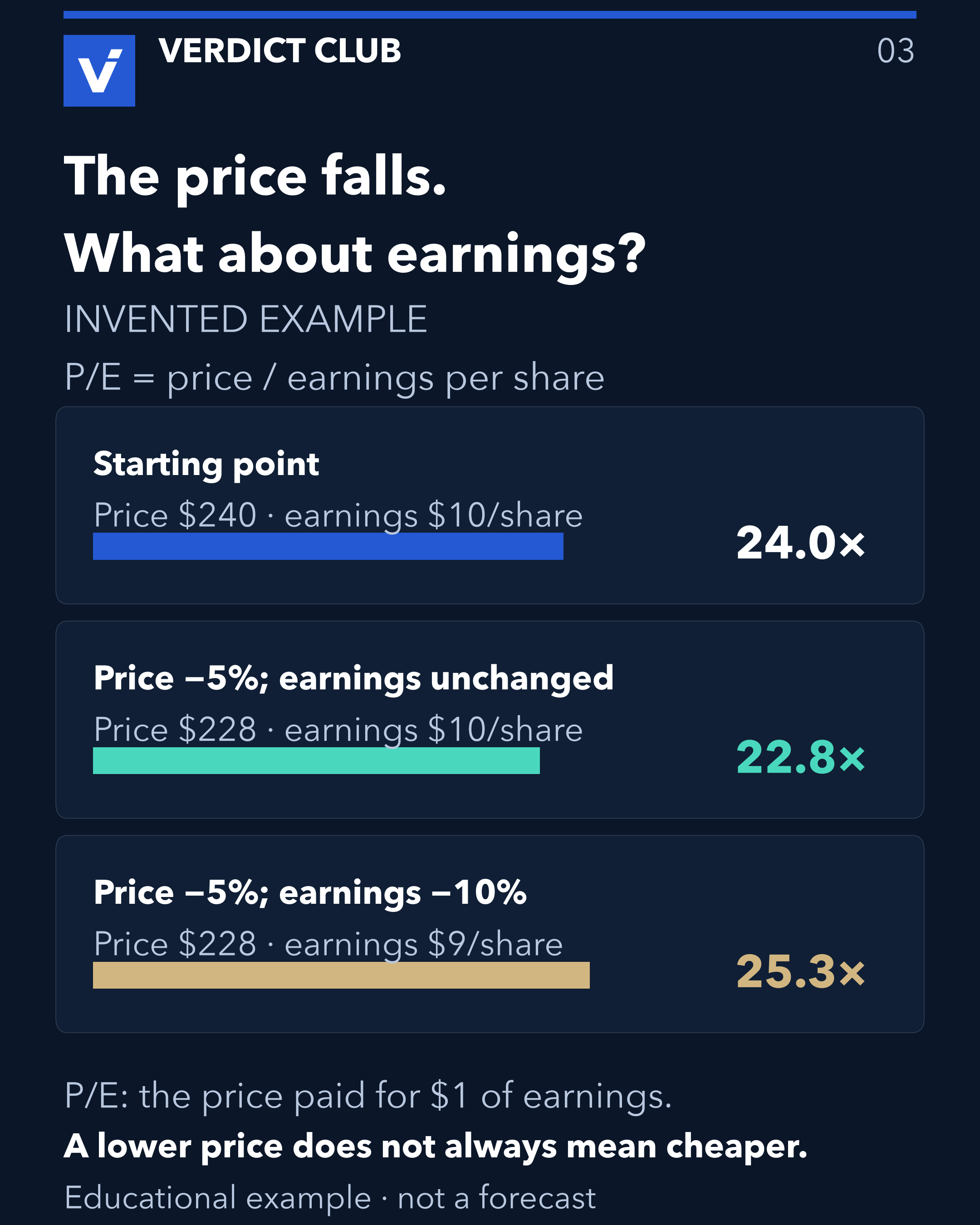
Invented example: a $240 stock with earnings of $10 per share has a P/E of 24. If its price falls to $228 while earnings remain at $10, the P/E falls to 22.8. But if earnings also fall to $9, the P/E rises to about 25.3.
In the last case, the share price is lower but the earnings-based valuation is higher than it was initially. A decline can create an opportunity, but it is worth checking whether only the price has fallen or the business has deteriorated too.
07 Special Reports
6. What I am watching next
Company earnings and forecasts: are sales, margin or investment estimates being revised?
Interest rates and the economy: are financing costs, consumer spending or growth prospects changing?
Concrete policies: which tax, budget or regulatory proposals are being made, and which have a chance of becoming law?
The price paid: does the valuation leave enough room for results weaker than expected?
I would not change a long-term analysis based only on election night. I would change it if evidence showed a material change in a company's revenue, profit, cost of capital or risks. Patience makes sense alongside that check, not instead of it.
Money needed in the near future also deserves to be treated separately from long-term investment capital. A falling market does not remove the risk of further losses or turn a near-term cash need into a long investment horizon.
08 Special Reports
Continue the analysis in Verdict Club
This report is public and you are welcome to share it. If you find the explanations useful, you can follow the page for free to receive future public material.
Verdict Club Insider membership includes full earnings analyses, charts explained step by step, daily market recaps, weekly reviews and access to the Discord community.
Educational material without personalized recommendations. Market data has separate timestamps and periods, stated in the text. Scenarios are not promises. Text and visuals created with AI assistance and editorial and numerical review.