01 Earnings Reports
At a glance
Free excerpt from the Apple Q4 FY2026 analysis. The quarter ended September 26, 2026, and results were published November 2. Comparisons are with the same quarter last year.
Apple sold more, but operating expenses grew faster. That is why operating profit rose more slowly than revenue. This does not mean profit fell. It means the company kept a slightly smaller share of each dollar of revenue.
02 Earnings Reports
What these figures mean
Revenue means company sales. Operating profit is what remains after the cost of products and services and expenses for research, selling and administration. Interest and taxes still need to be considered to reach net income.
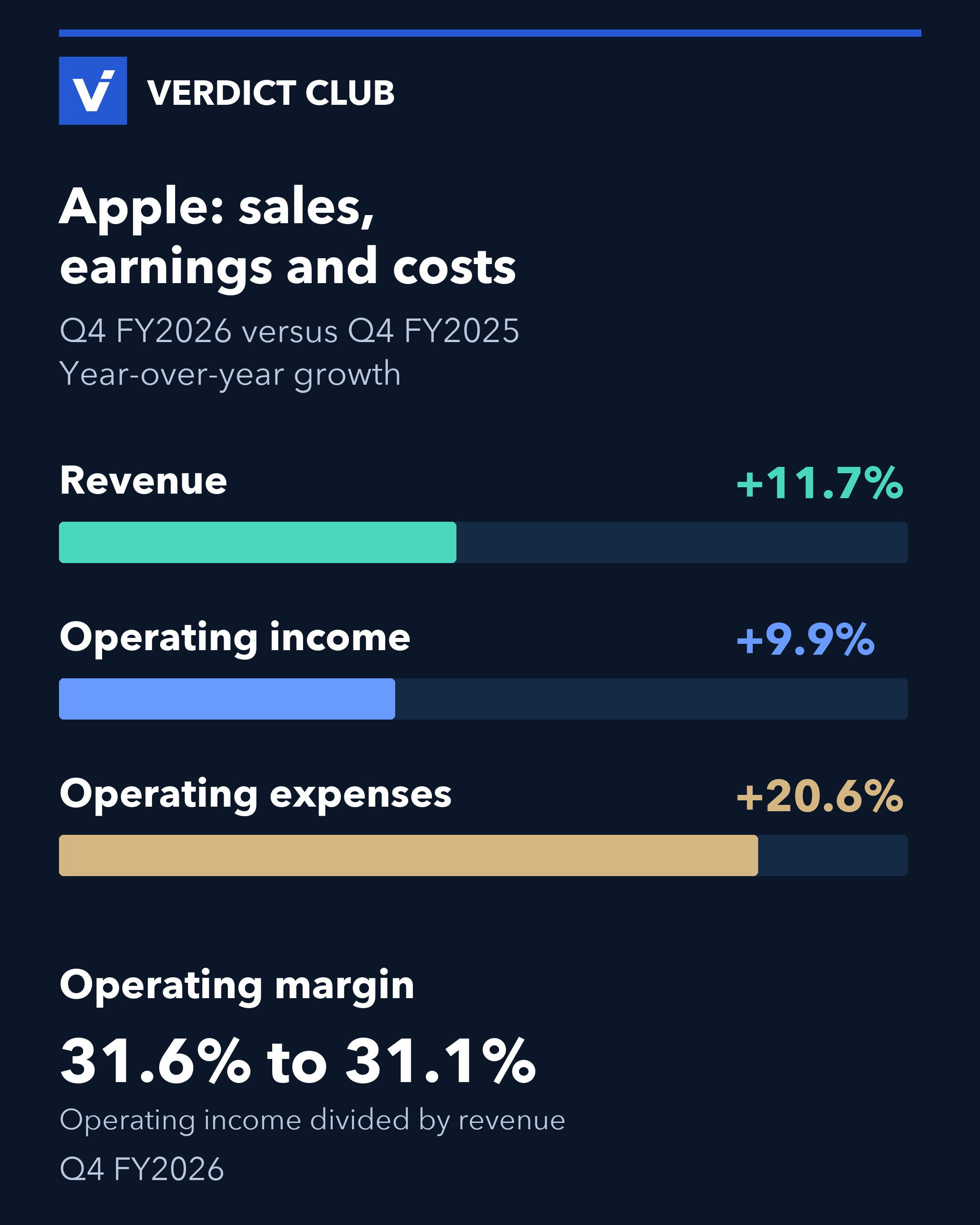
In the reported quarter, revenue grew 11.7%, while operating profit grew 9.9%. Operating expenses rose 20.6%. These include research and development plus selling and administrative expenses; they exclude direct product and service costs.
Operating profit divided by revenue is called the operating margin. At Apple, it fell from 31.6% to 31.1%. The company earned more profit in dollars, but slightly less relative to sales.
03 Earnings Reports
A simple example
Invented example, not Apple's figures: a company makes sales of 100 lei. Direct costs are 60 lei, and other operating expenses are 10 lei. That leaves 30 lei in operating profit.
The following year, sales reach 110 lei. Direct costs rise to 66 lei and other expenses to 13 lei. That leaves 31 lei in operating profit.
Sales grew 10%, but profit only 3.3%. The company earns more in total, but keeps less of each leu of sales. The same mechanism explains why sales and expenses need to be read together.
04 Earnings Reports
What to watch next
Higher spending is not automatically a problem. Research can support future products and services. The question is whether the money spent will generate enough sales and profit over time.
The risk arises if expenses keep growing quickly while sales slow. Profit may then come under pressure. One quarter does not establish the long-term direction, however.
At the next report, I would compare sales growth, expenses and operating margin again. I would look for profitability stabilizing, rather than judging the result only by revenue growth.
In the full analysis, I also explain the contribution of iPhone and Services, cash, inventory, management's outlook and the stock's valuation.
Read the full Apple analysis — included in Verdict Club Insider membership.
Educational material. Text and chart created with AI assistance and numerical verification.